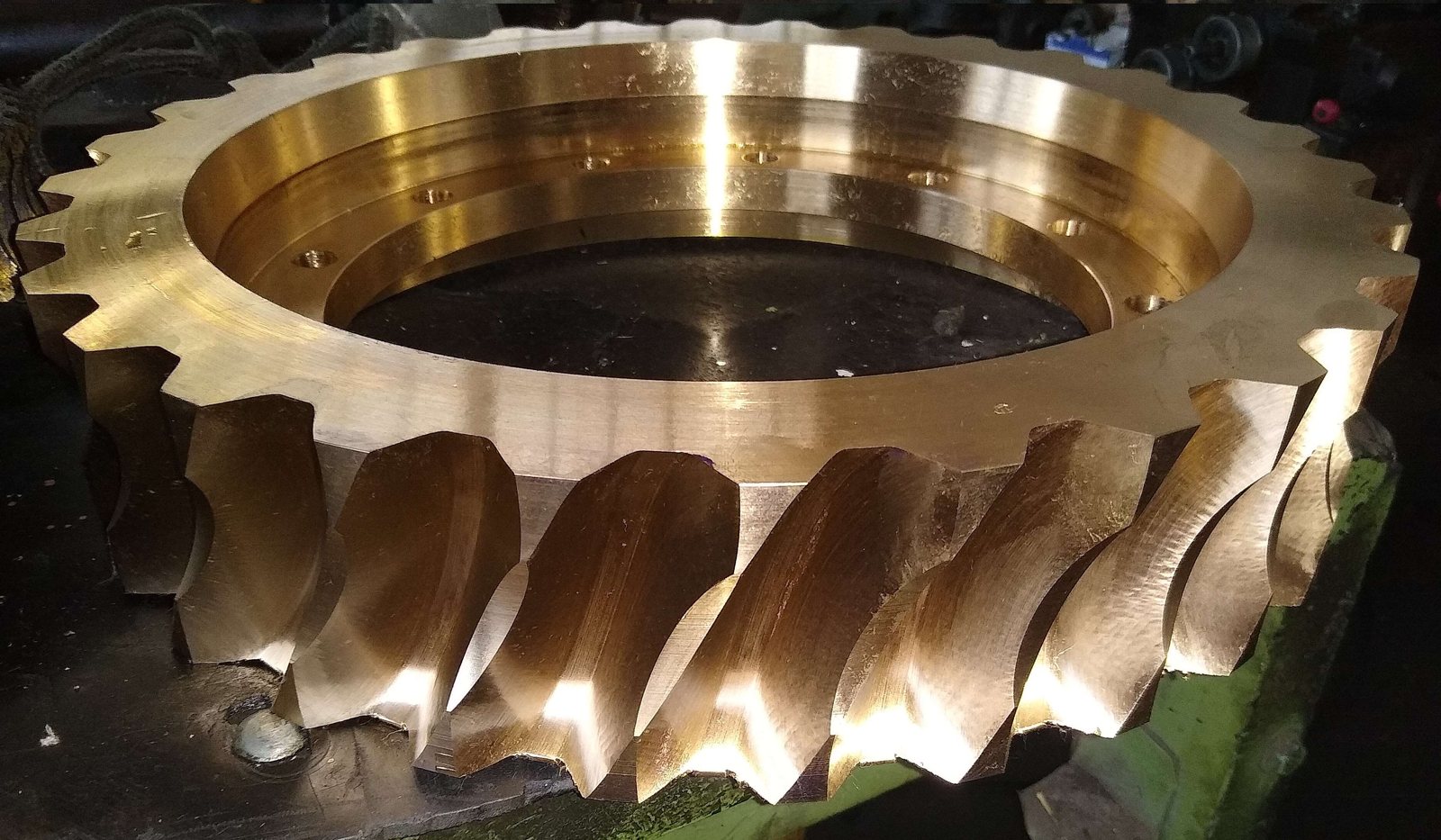
How the set works
The worm transmits motion to the wheel, with shafts normally at 90°. Each worm revolution advances the wheel by a number of teeth equal to the number of worm starts, allowing high reduction ratios in a compact space.
Unlike cylindrical gear meshing, contact involves substantial sliding between the worm thread and wheel tooth. This determines material selection and service behaviour.
Why the wheel is made of bronze
The usual pairing combines a steel worm, generally hardened and ground, with a bronze-alloy wheel. Bronze performs well in sliding contact against steel and wears in a controlled manner.
This controlled wear is intentional: the wheel acts as the sacrificial component. Replacing it is preferable to damaging the worm, whose manufacture involves thread cutting and grinding.
Starts, lead angle and geometry
The number of starts determines transmission ratio and influences efficiency. Single-start sets provide high reductions; increasing the number of starts changes lead angle and meshing behaviour.
Our experience includes sets with up to 13 starts, right-hand or left-hand threads, lead angles up to 55 degrees, pressure angles from 14.5° to 30°, and ZI, ZN, ZK and CAVEX geometries. The wheel must suit its specific mating worm and the equipment’s centre distance.
What to look for when assessing wear
- Increased angular backlash at the output
- Contact displaced towards one end of the tooth
- Thinned wheel teeth or altered tooth profiles
- Scored worm threads or adhered material
- Increasing drive temperature and noise
Reconditioning the set
When the wheel core is sound, full re-cutting can restore tooth geometry. Otherwise, a new wheel is manufactured from a technical drawing, physical sample or existing physical worm, frequently for older machines without available replacements.