How tooth geometry differs
In a spur gear, the teeth are parallel to the axis of rotation. Pairs of teeth enter and leave contact abruptly, across the full face width at the same time.
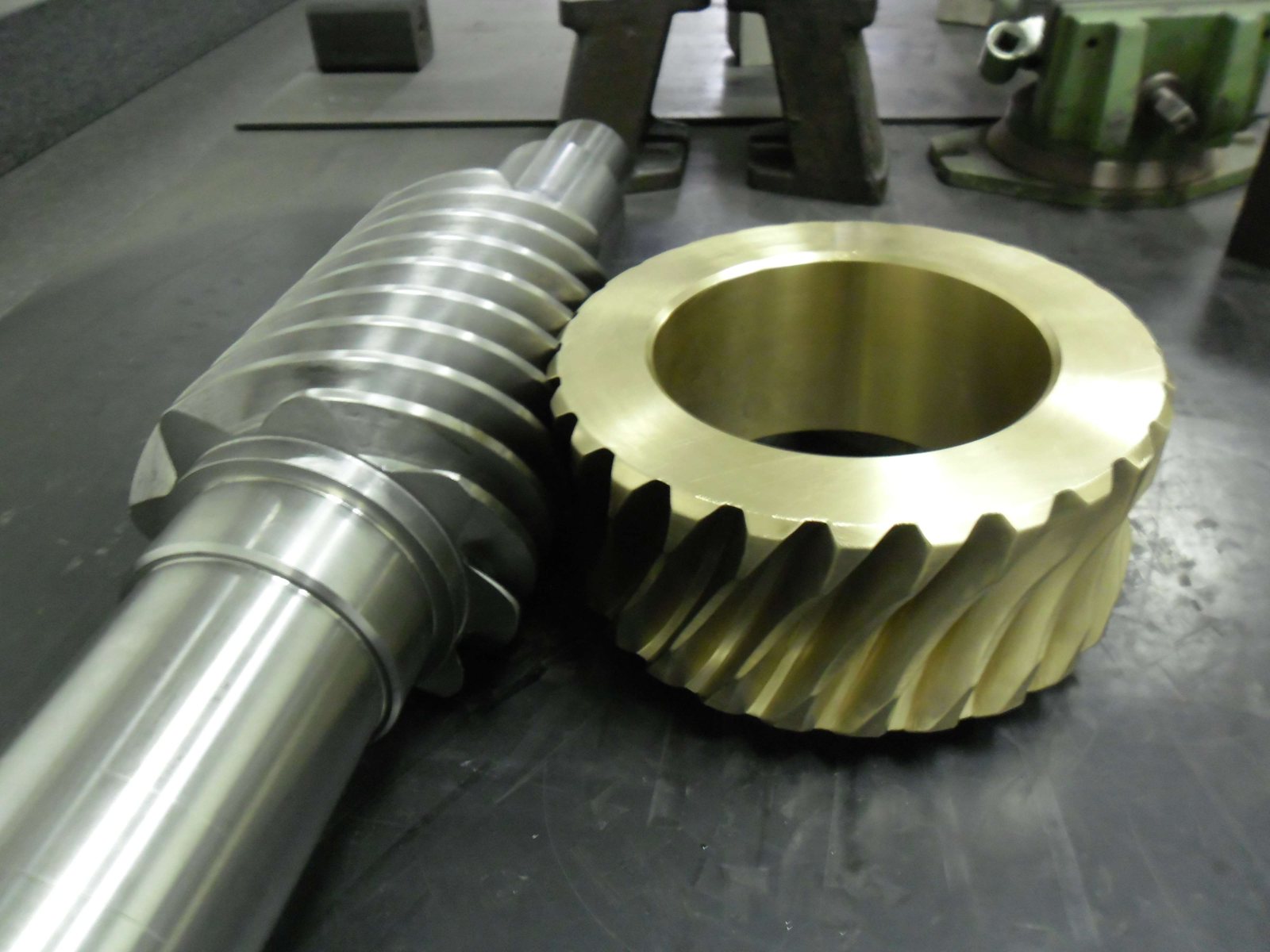
In a helical gear, the teeth are inclined relative to the axis. This inclination is the helix angle. Contact begins at a point and progresses diagonally across the tooth face, so that more than one pair of teeth remains in mesh.
Practical effects on equipment
Noise and smoothness
Because the teeth engage progressively, a helical gear generally runs more quietly and with less vibration than a spur gear at the same rotational speed. In continuous-process machinery, this is often the deciding factor.
Load capacity
With more teeth in contact simultaneously, the load is distributed more effectively in a helical gear. Within the same available space, it generally carries a higher load than an equivalent spur gear.
Axial thrust
The tooth inclination generates a force component along the shaft. The bearings must absorb this axial thrust, influencing assembly design. Spur gears do not generate this component, which is why they remain widely used in simple drives and sliding gear assemblies.
How this affects component replacement
During maintenance, the choice has normally already been made in the original design: the new component must reproduce the geometry of the one removed. Replacing a spur gear with a helical gear, or vice versa, changes assembly behaviour and bearing forces and prevents meshing with the existing mating gear.
The dimensional assessment must record tooth type, module, tooth count, pressure angle and face width, as well as helix angle and hand for helical gears, which may be right-handed or left-handed.
What to send for a quotation
- A technical drawing, if available
- Module and number of teeth, if known
- Outside diameter, face width and bore or shaft dimensions
- Tooth type: spur or helical, including helix hand
- Original material and heat treatment, if known
- Photographs of the component and assembly to support preliminary evaluation
- The physical sample, when it can be sent