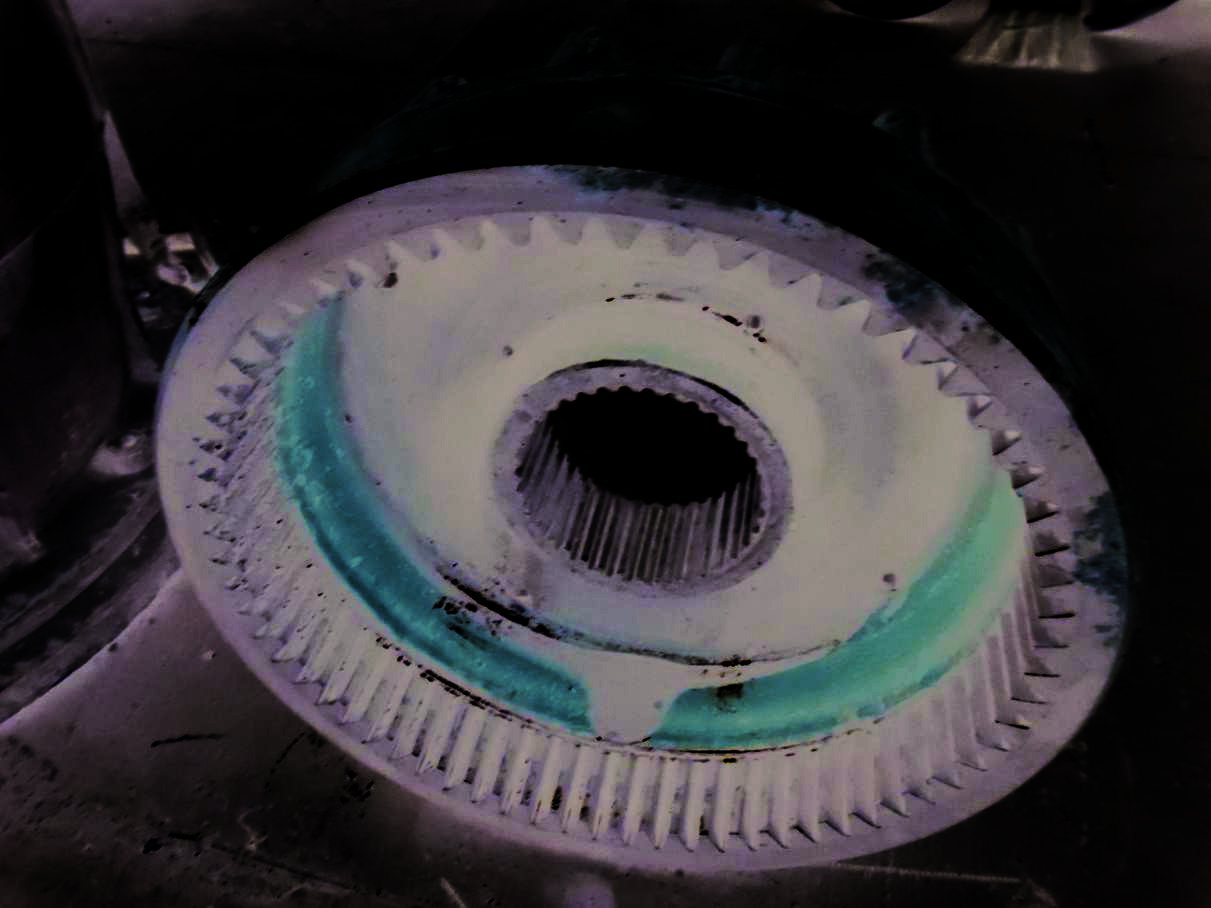
Warning signs before visual inspection
- Noise that changes with load or rotational speed
- Noticeable vibration in the gearbox housing or bearing support
- Higher-than-normal temperature around the drive
- Increased backlash when reversing direction
- Metal particles in the oil or on the magnetic drain plug
Wear patterns on the tooth flank
Abrasive wear
Uniform material loss from the flank thins the tooth profile and changes contact geometry. Often associated with contaminated lubricant or insufficient lubrication, advanced wear can thin the tooth until its strength drops sharply.
Pitting: contact fatigue
Small cavities, generally near the pitch line, indicate fatigue caused by contact pressure. Initial, stable pitting may not require a shutdown. When cavities merge and material breaks away, the tooth loses its profile and noise increases.
Scuffing and smearing
Scoring in the sliding direction with a smeared appearance points to lubricant film failure under load or at high temperature. Repairing the component without reviewing lubrication and loading is likely to result in the same failure recurring.
Tooth breakage
Breakage may follow a single overload event such as jamming, impact or a foreign object entering the mesh, or root fatigue where a crack progresses until the tooth breaks. Fracture location helps distinguish the cases.
Uneven contact caused by misalignment
A contact pattern concentrated at one end of the face width normally points to shaft alignment, bearing condition or housing deformation, rather than the gear itself.
Recondition or manufacture a new component?
The decision depends on damage depth, material, treatment and function. Surface damage on large components may justify reconditioning. A compromised profile, root crack or significant dimensional loss normally calls for a new component.
The mating component must also be assessed: replacing only one component of an already worn pair often brings the next shutdown forward.